Bigger, Smaller, Weirder: What America's Most Famous Landmarks Actually Look Like Up Close
Bigger, Smaller, Weirder: What America's Most Famous Landmarks Actually Look Like Up Close
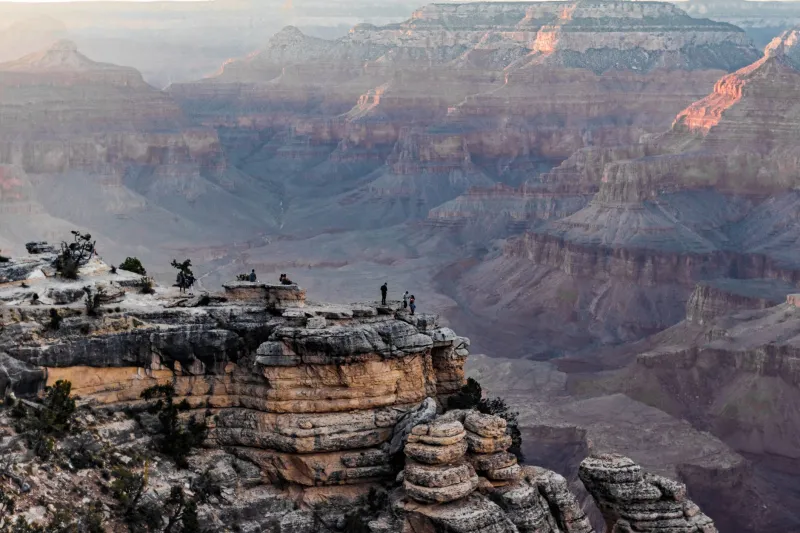
There's a particular kind of silence that falls over people the first time they see the Grand Canyon in person. It's not awe, exactly — or at least, not the clean, cinematic awe you were promised. It's more like your brain buffering. The scale refuses to compute. Your eyes keep trying to locate a far wall, a ceiling, some edge that makes spatial sense, and they keep failing. That's when it hits you: every image you've ever seen of this place was a lie. A well-meaning, technically accurate lie — but a lie all the same.
This is a phenomenon so common it practically has its own genre of travel writing. The gap between the landmark we carry in our heads and the landmark that actually exists is one of the most genuinely interesting disconnects in American culture. And here at 1Wiki, where the whole point is exploring the world together with honest, shared knowledge, it felt like exactly the kind of thing worth pulling apart.
So let's do that.
The Grand Canyon: Too Big to See
Here's the paradox nobody warns you about: the Grand Canyon is so enormous that photographs make it look smaller than it is. A camera lens has to compress roughly 277 miles of river canyon, some of it nearly 18 miles wide and over a mile deep, into a 4x6 rectangle. The result is something that looks dramatic but manageable — like a very impressive ditch.
In person, the sense of depth is genuinely disorienting. Most visitors report that their first instinct is to step back from the rim, not because of any real danger, but because their nervous system just doesn't trust what it's seeing. The Colorado River at the bottom, which looks like a thin brown thread from the South Rim, is actually 300 feet wide in places. That "thread" is a serious, churning river. The canyon doesn't look like the postcards. It looks like a different planet.
And yet, weirdly, a lot of visitors also report a creeping feeling that it's somehow too still. No movement, no sound from the bottom, no sense of scale to anchor the eye. The expectation, shaped by decades of dramatic film shots and nature documentaries, was something more dynamic. The reality is vast and quiet in a way that takes time to settle into.
Mount Rushmore: The Parking Lot Nobody Mentions
If the Grand Canyon suffers from being impossible to photograph accurately, Mount Rushmore suffers from the opposite problem — it photographs too well. Directors love it precisely because a telephoto lens can isolate those four faces against the sky and make them look like they're floating above the Black Hills in godlike solitude.
What you don't see in the movies: the viewing area is a tidy, somewhat compact plaza with a gift shop, an ice cream stand, and a fairly steady flow of tour groups. The faces themselves — Washington, Jefferson, Roosevelt, Lincoln — are genuinely impressive up close, carved with remarkable precision into the granite. But each face is only about 60 feet tall. That's roughly the height of a six-story building. Respectable, certainly. Continent-defining? That's the camera work talking.
There's also the matter of what the mountain used to look like. The original design called for the presidents to be carved from head to waist, showing their full torsos. Funding ran out in 1941, and the project stopped with just the faces. The version in your head — the "complete" monument — was never actually finished. You've been picturing the concept art.
The Mississippi River: Wide, Brown, and Surprisingly Ordinary in Places
Ask most Americans to picture the Mississippi River and they'll conjure something majestic — wide blue water, dramatic banks, maybe a steamboat for good measure. The reality is considerably more complicated depending on where you encounter it.
Near its source at Lake Itasca in Minnesota, the "Mighty Mississippi" is so narrow and shallow that you can wade across it in flip-flops without getting your shorts wet. Seriously. Tourists do it every summer. The river that drains 40% of the continental United States starts as something you could hop across on stepping stones.
By the time it reaches New Orleans, it's genuinely imposing — over half a mile wide in places, carrying an almost unsettling amount of brown, sediment-heavy water. But even there, it doesn't look like the romantic river of literature and song. It looks industrial. Busy. Lined with ports and loading equipment and the working infrastructure of a major commercial waterway. Which is, of course, exactly what it is. The romance of the Mississippi is real, but it lives in history and story more than in the view from the bank.
Niagara Falls: The Tourism Factor
Niagara Falls is genuinely spectacular — let's get that on the record. The volume of water going over those falls (about 3,160 tons per second on the American side alone) is a hard thing to argue with. But the experience of visiting is shaped so heavily by the surrounding tourist infrastructure that it can feel more like a theme park than a natural wonder.
The Canadian side, which offers the more dramatic panoramic view, is backed by a skyline of hotels and casinos that appear in virtually every wide shot. The American side has its own challenges — the viewing areas are close and loud, which is thrilling, but the falls themselves are partly diverted for hydroelectric power. Up to 75% of the water is redirected at night and during tourist off-season. What you're seeing during peak summer hours is essentially the "show" version, curated for visitors. The full natural flow has never been seen by living humans.
So Why Does the Gap Exist?
The short answer is selection bias — we only see the best photos, the most dramatic angles, the shots taken in perfect light by skilled photographers with excellent equipment. Textbooks pick the most iconic image. Movies use the most cinematic composition. Over decades, these curated representations become the "real" version in our minds, and the actual place becomes the copy.
The longer answer involves something more interesting: we want our landmarks to be mythic. There's a reason we keep choosing the telephoto shot of Mount Rushmore over the one that includes the gift shop. The myth serves a purpose. It tells a story about who we are and what we've built and what nature has given us.
But there's real value in the honest version, too. The Grand Canyon that buffers your brain. The Mississippi you can wade across. The monument that was never finished. These places are stranger, more complicated, and — once you get past the initial recalibration — more interesting than the postcard.
Have your own "wait, that's it?" moment at a famous landmark? Drop it in the comments. That's the whole point of this place — the map gets better when everyone contributes to it.