Your Mental Map of America Is Probably Wrong — Here's the Proof
Your Mental Map of America Is Probably Wrong — Here's the Proof
Here's a quick experiment. Close your eyes and picture Lake Michigan. Got it? Now — which side of the lake is Chicago on? If you said the western shore, congratulations, that's technically correct. But ask most people to sketch it freehand and Chicago ends up somewhere near the middle of the lake's bottom edge, or occasionally floating off the eastern side entirely. It's a small thing. It's also completely wrong, and you've probably been wrong about it for years without anyone ever telling you.
That's kind of the whole story here.
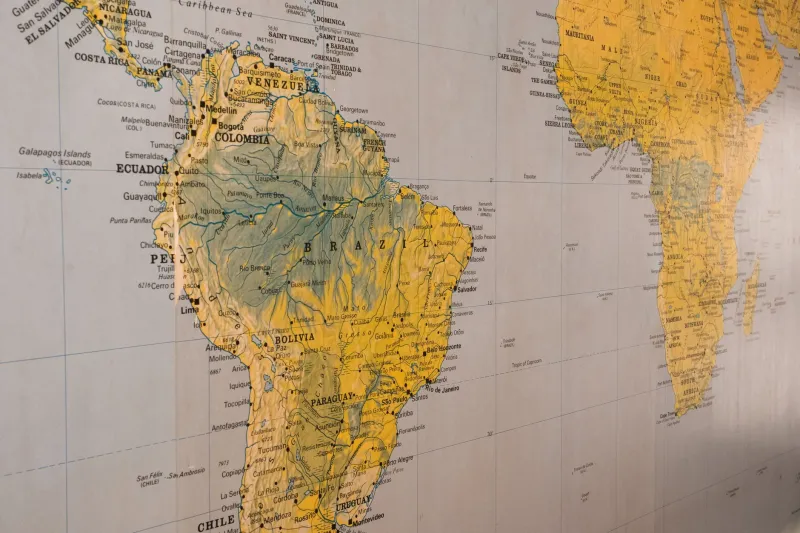
America is a big, complicated place, and the maps most of us learned from — those laminated wall posters in fourth grade, the tiny corner graphics in history textbooks, the wildly distorted outlines plastered on everything from coffee mugs to state-pride T-shirts — were never really built for accuracy. They were built for convenience. And convenience has consequences.
At 1Wiki, we've been collecting reader-submitted geographic assumptions for a while now, and what's come back is genuinely humbling. Not because people are uninformed. But because the misinformation is so consistent, so shared, that it starts to feel like a collective hallucination we've all agreed to participate in.
The Great Lakes Are Way Further North Than You Think
Let's start with the big one. Ask someone to point to the Great Lakes on a blank US outline and they'll almost always place them too far south and too far east. Lake Superior — the largest freshwater lake in the world by surface area — sits at roughly the same latitude as the northern tip of Maine. Its northern shore is Canadian territory, pressing up against Ontario in a way that most Americans never really register.
More surprisingly, Lake Erie — the one everyone vaguely remembers as the shallowest and most pollution-troubled — is the southernmost of the five lakes, sitting at roughly the same latitude as northern Oregon. That detail alone tends to short-circuit people's mental geography, because Oregon feels west and Erie feels east, and somehow the brain refuses to let them share a latitude.
The collective shape of the lakes also gets mangled. Superior is enormous — genuinely, absurdly large. It could swallow the entire state of South Carolina with water to spare. But on most classroom maps, it looks roughly comparable to Michigan or Huron, which are themselves massive. The scaling is almost always off, which means the sense of just how much freshwater is sitting in America's backyard never quite lands the way it should.
The Mississippi Doesn't Flow Where You Picture It
Here's another one that hits hard: where does the Mississippi River start? Most people guess somewhere in the middle of the country — maybe the Dakotas, maybe Kansas, somewhere vaguely central. The actual answer is Lake Itasca in northern Minnesota, which is so far north that it's only about 150 miles from the Canadian border.
From there, the river runs south for roughly 2,300 miles before emptying into the Gulf of Mexico south of New Orleans. That part most people know. What surprises them is the path it takes to get there — specifically, how far east the river runs in its lower stretches. Memphis, Vicksburg, Natchez, Baton Rouge — these cities feel like they should be in the center of the country. On a mental map, they often are. In reality, they're hugging the eastern edge of the river's course, with the Mississippi forming much of the western boundary of Tennessee and Mississippi before angling toward Louisiana.
The mouth of the river, where it fans out into the Gulf, is also further south and further east than most people expect. New Orleans isn't sitting right at the mouth — the actual delta extends another 100 miles southward into the Gulf, a fragile, sinking stretch of land that doesn't appear on most maps at all.
The Continental Divide Is Not a Straight Line Down the Rockies
When people think of the Continental Divide — the ridge that determines which way water flows, either toward the Pacific or toward the Atlantic and Gulf — they tend to picture a clean north-south line running down the spine of the Rocky Mountains. Neat. Logical. Wrong.
The actual Divide is famously, almost comically, irregular. In Wyoming, it splits around a feature called the Great Divide Basin, an area of internal drainage where water doesn't flow to either ocean — it just pools and evaporates. The Divide loops around this basin in a shape that looks less like a geographic boundary and more like someone traced it while distracted.
In New Mexico, the Divide swings dramatically westward. In Montana, it cuts through Glacier National Park in ways that feel counterintuitive when you're standing there. And in Colorado — the state most people associate with the Divide — it crosses under the Eisenhower Tunnel on I-70, meaning millions of drivers have crossed it without realizing they just passed from Atlantic-draining to Pacific-draining territory at 70 miles per hour.
The Appalachians Are Older — and Taller in Your Head — Than You Realize
The Rockies get all the glory. They're dramatic, photogenic, and conveniently located near enough to major western cities that they've become the default image of American mountains. The Appalachians, by contrast, get treated like a gentle afterthought — rolling, forested, quaint.
But the Appalachians are ancient in a way that changes how you look at them. These mountains were once comparable in height to the Himalayas. They've just had 480 million years to wear down. What's left is rounded and softer, yes, but the system stretches from Alabama all the way to Maine — a continuous chain that most people dramatically underestimate in terms of length.
What also surprises people: the highest point in the eastern United States, Mount Mitchell in North Carolina, tops out at 6,684 feet. That's not Rockies-level, but it's not nothing either. And it sits in a range that most Americans mentally file as "not really mountains."
Why Does This Keep Happening?
The honest answer is that maps are designed to communicate, not to convey truth perfectly. Projections distort. Scales compress. And the maps that stick with us longest — the ones from elementary school, the ones on the classroom wall for six hours a day — were chosen for durability and price, not cartographic precision.
Pop culture doesn't help. Movies set "in the Midwest" are often filmed in places that look nothing like the Midwest. TV shows gesture vaguely at geography without committing to it. Even news graphics, which should know better, routinely misplace things for visual clarity.
The result is a country full of people who are deeply, genuinely attached to a version of their home that's slightly — sometimes wildly — off. And the weird thing is, once you start noticing, you can't stop. The Mississippi isn't where you thought. The Great Lakes are further north. The Divide isn't a line.
Your map lied. But now you know.
Got a geographic assumption that turned out to be completely wrong? Share it in the comments — we're building a community map of American misconceptions, and your contribution might end up in a follow-up piece right here on 1Wiki.